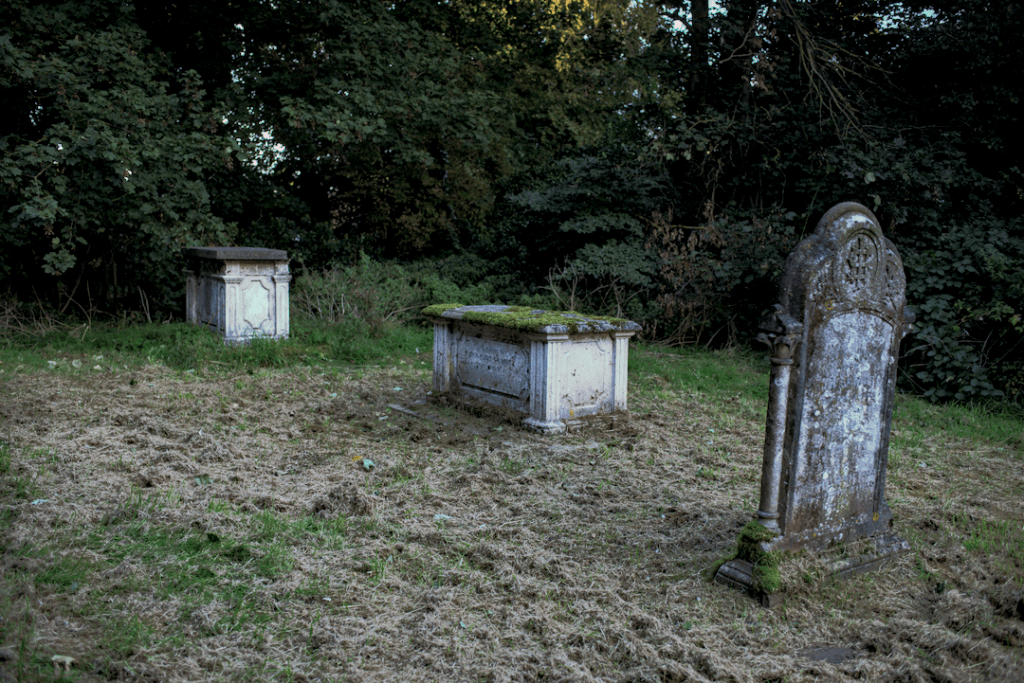
St Margaret and two St Marys.
St Margaret of Antioch, Leiston.
There is another St Margaret of Antioch, a few miles away in Linstead Parva, next to a tributary of the Blyth. The land rises beyond that church towards Nunn’s Hill, and behind it’s double gate and Victorian lantern, the church sits low in the soft ground. Released by damp leaves and dried branches. The Leiston St Margaret stands at the end of a long rising cemetery across the road from Urban Combat Leiston. Even on this rain-soaked day, the stone resists and the cast iron drains endure. Near Holly Tree Close, cut grass is clumped in small piles. A deep carpet around a low flat monument in white stone. Fluted pilasters flecked with lichen and dried grass. Trees by the church gate drip onto a slab sitting like a misaligned lid on a stone box.
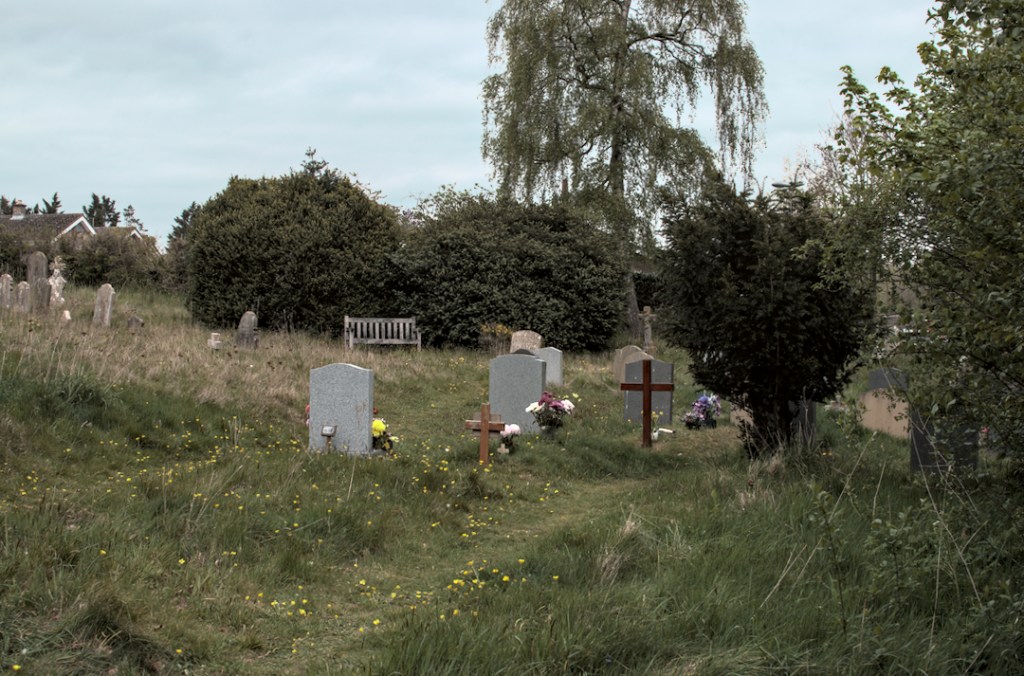
St Mary’s, Chediston.
St Mary’s church Chediston has smooth walls, except for the sturdy square bell tower. Parts of the church are nearly 1000 years old. Blyth St Mary’s Chediston Valley Churches website welcomes all who want to pray and worship. Following restoration work in the tower, the bells were rededicated a few years ago. The website describes this part of Suffolk as peaceful and remote. It is quiet in a dull summer haze. I can just hear the road, beyond the track to the church carpark and a tiny, humped bridge. A steam is lost below the overhanging branches and among the fields which spread towards Halesworth and Lindsted Parva.
There are holiday flats behind the trees and a trout fishing pond, up the hill, past the bend with a red telephone box, set back from the road, now used to store emergency medical equipment. There is a gentle buzz. Perhaps it’s in the shuffle of the tall dry grass, or the murmur of machinery, muted in the warm low clouds.
I lowered the stand and stood my bike up. Buttercups and long-stemmed poppies. Bright roses by newly carved head stones. A red wooden cross and a park bench tucked into bushes. White plastic facia boards above a hedge. There is a sound, perhaps a radio, coming from the house along the track. There is a movement in the conservatory. The long grass is shimmering around my bike now. The ski is darker as I ride away crunching stones and weaving between the tufts of grass, imagining I can hear thunder.
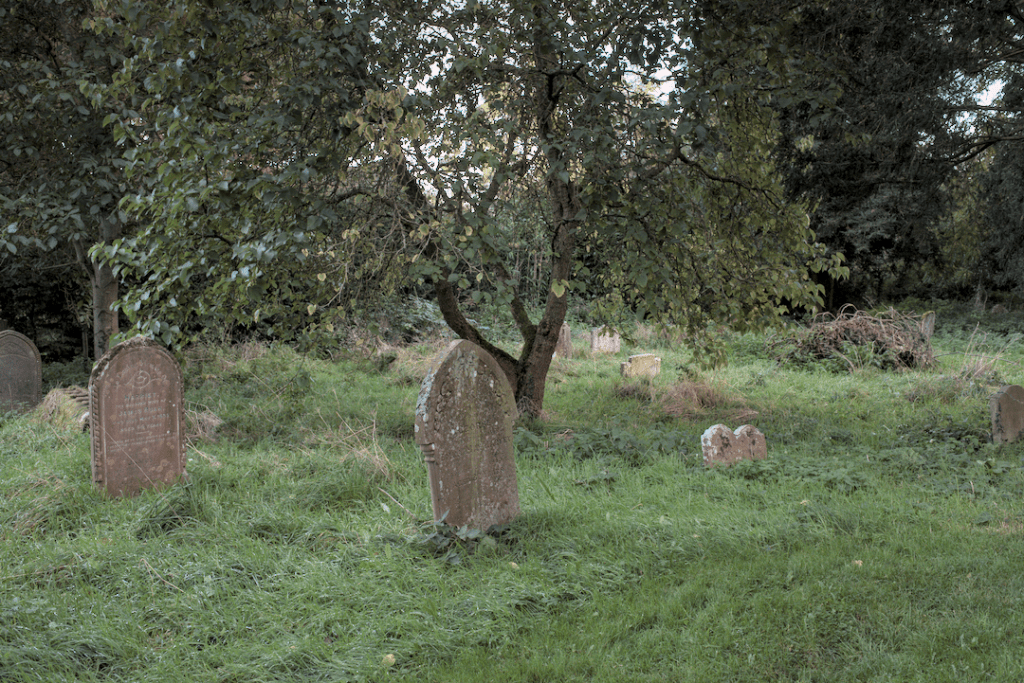
St Mary The Virgin, Huntingfield.
I have come again to this church on a late autumn evening. The interior has a remarkable flight of angels above the nave, but I am drawn to the churchyard. A lush pasture of grass, stone, and trees with drooping branches. The grass is already damp, overhanging the narrow path, heavy with dew, which soaks my shoes. The church lies between The Street and Barrells Hill. Through a low wire fence, I can see a narrow road turning through a tidy field, neat and clipped like English parkland, towards a redbrick house. Families who arrived with the Norman conquest still own lands in Suffolk.
A copper light burns through gaps in the branches and falls on leaves, already pale. Below them, an irregular row of gravestones, some tilting away from the wind, others like a single cross, lean forward, precarious on a low stone plinth. In a moment the light is fading and I notice a twin headstone dwarfed by the others, almost overcome with nettles and grass. Wee bairns perhaps.
 Andy Small
Leave a comment