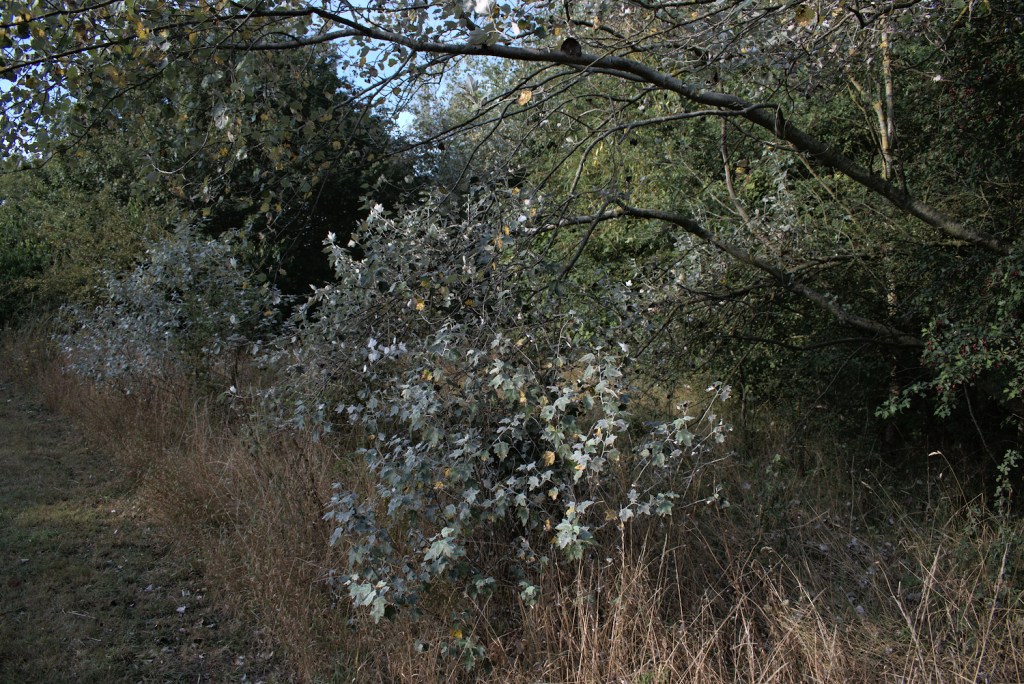
On a road made muddy by lorries from an aggregate site, opposite a packaging works and the remains of a wartime airfield, I am stunned by a spray of silvered leaves.
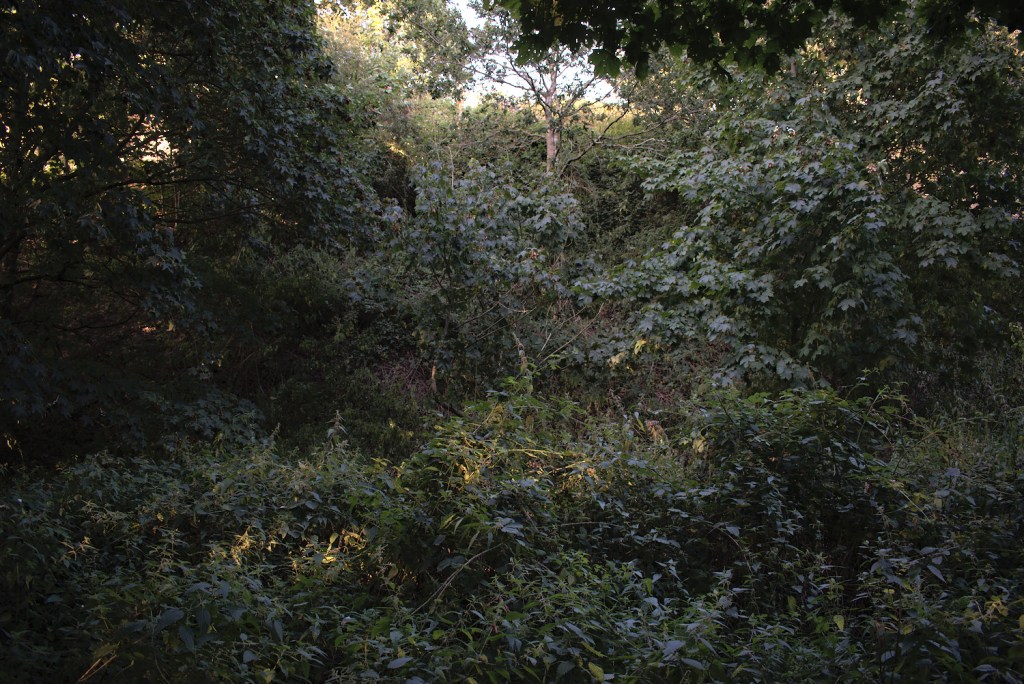
Through a disused gravel pit the path descends along a covered track. Towards Blyford the path is difficult with deep ruts made by small tractors. The canopy of trees is still dense in Winter, and the potholes still damp in Spring. Sand and gravel below the sparse weeds and grass, and dense thickets on either side of the path. On this late summer evening I can see the bright sky between the branches and peer into the warm deep shadow below. I did not know then that a small pond pierced by tree sumps and fallen branches, lay beyond, pressed against the steep walls of the pit, near an old timber yard and a dog walkers makeshift car park.
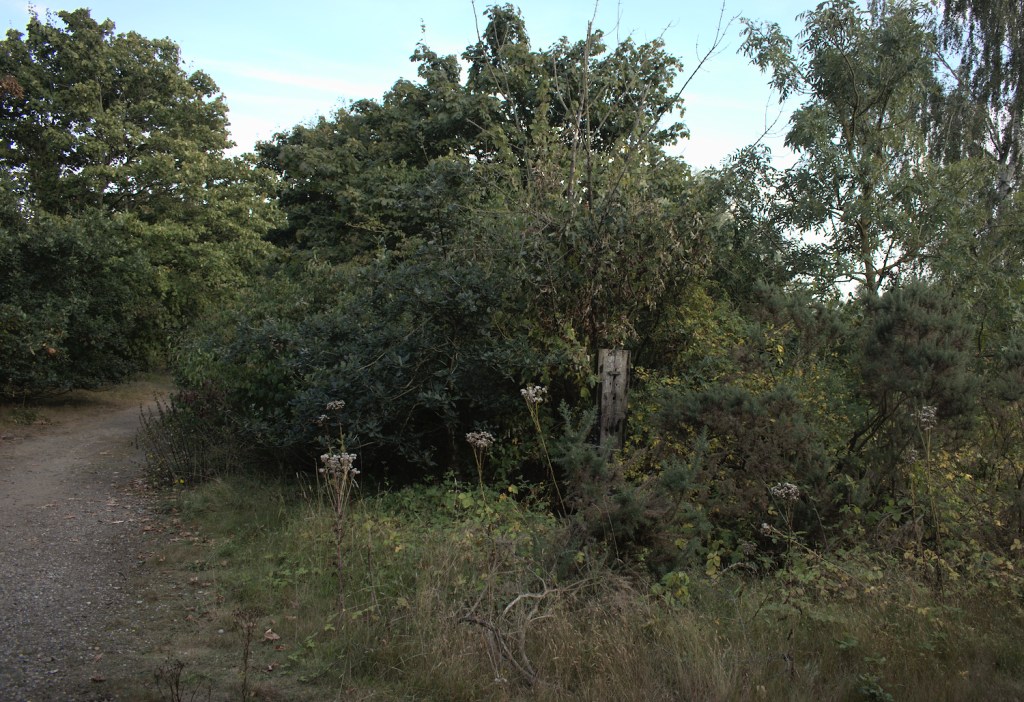
The path continues flatter and lower by a gatepost and a gap in the hedgerow. Low industrial buildings and a fishing lake hidden by trees – licenses from The Woodbridge Angling Society. A rank of standing seedheads, a gatepost, and thickets and plants like an embroidered wild garden. Adam Nicolson describes how the writers of the King James version of the Bible, framed their vision of paradise from descriptions of Dominican forests in the newly discovered Caribbean.

In Mells the roadside bank rises thick with Blackberry, just hiding the ruins of a chapel. Flint and soft mortar. Opposite Old Chapel Farm the road falls gently towards the road from the level crossing at Brick Kiln Farm to Wenhaston. The hopper of an aggregate quarry is rusting green. Gravel and sand are gathered in the middle of the junction. The path by Halesworth Golf Course squeezes between the deep cut of a stream and block work farm buildings. The path continues, crossing a main road and the Lowestoft to Ipswich line at Railway Wood. I turn east along the top of a drainage ditch that looks freshly cut. Moist stones gathered in piles. The path takes the higher ground and I can just see Blythburgh Parish Church. Where the path meets the road the copper evening light is traced across the hedgerow. I was asked directions from a Land Rover pulling up on the dry stones. I sent them in the direction of Wenhaston, but realised days later, they must have been looking for Blackheath and the holiday cabins.

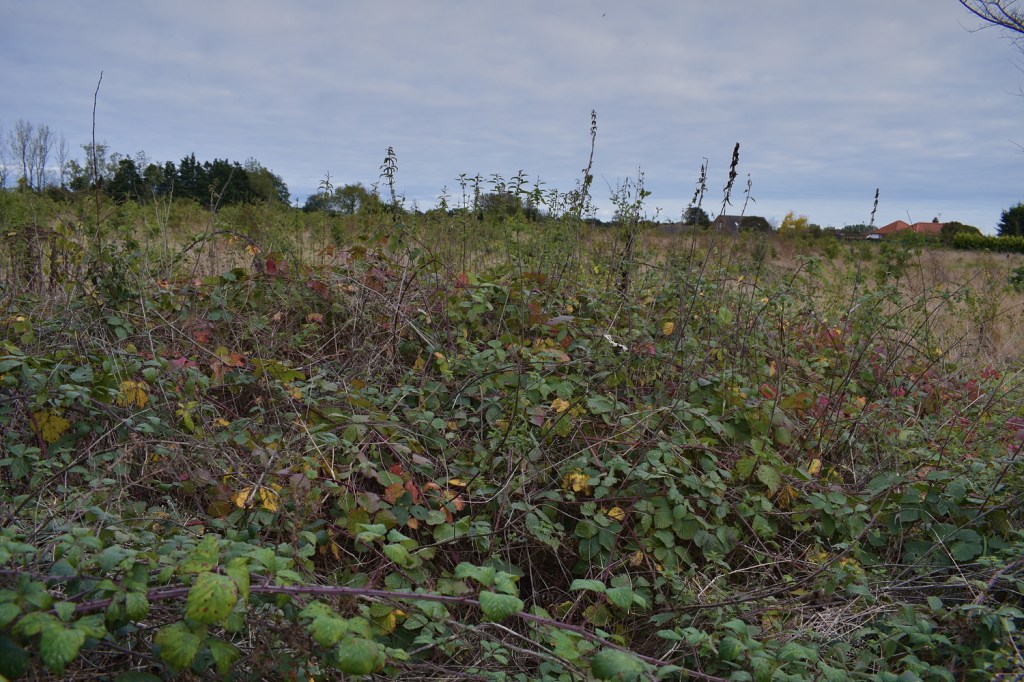
Behind the brand-new houses in the estate growing at the top of Hill Farm Road, brambles and blackberry bushes engulf the land towards Orchard Valley. This will soon be built on. Loam Pit Lane rises steeply, past allotments and the Halesworth Cemetery. Across the football pitch, ornate chimneys and the bell tower of the beautiful Patrick Stead Hospital, now permanently closed. The Halesworth open-air swimming pool is lost. The puddled changing rooms, the poolside grass banks, the extra high wire fence, the laughter, the wet footmarks on warm terracotta tiles. On this high ground, where the Halesworth Middle School along with its sports hall, were demolished, the cricket nets are already engulfed.

On a darkening winter afternoon, I am walking on a narrow damp path besides Theberton church. Not far from where the Southwold Infants School teacher, Miss Bonsey died in a car crash before the millennium. We did not know her, but my father was shocked. I am looking at the restorations, how each flint is set in a mortar of sand and grit. The church once maintained the graves of German airmen. Their slowly turning Zeppelin was shot down in the early hours of a June night of 1917. The previous afternoon, after crossing the North Sea, its bombs mostly falling in open fields, the airship turned again towards the open sea at Harwich. Suffering compass and engine trouble it was blown back inland and in the dark it was knotted with gunfire. Tracer bullets from the Royal flying Corps dimly lit the descending hulk. Aerial photographs of the crash site show a skeleton of cinders, laid out like a monstrous fossil in the fields between Eastbridge and Theberton. I can remember seeing a Norman arch inside the church. Tantalizingly low and zigzagged in stone. Today I am too cold to imagine those Christian Normans trudging through Suffolk fields, or German airmen looking down on their targets at Kirton and Martlesham. The hedgerow is thick and entangled. Instead, I think about John Sell Cotman or Richard Dadd, The Fairy Feller’s Master-Stroke perhaps.
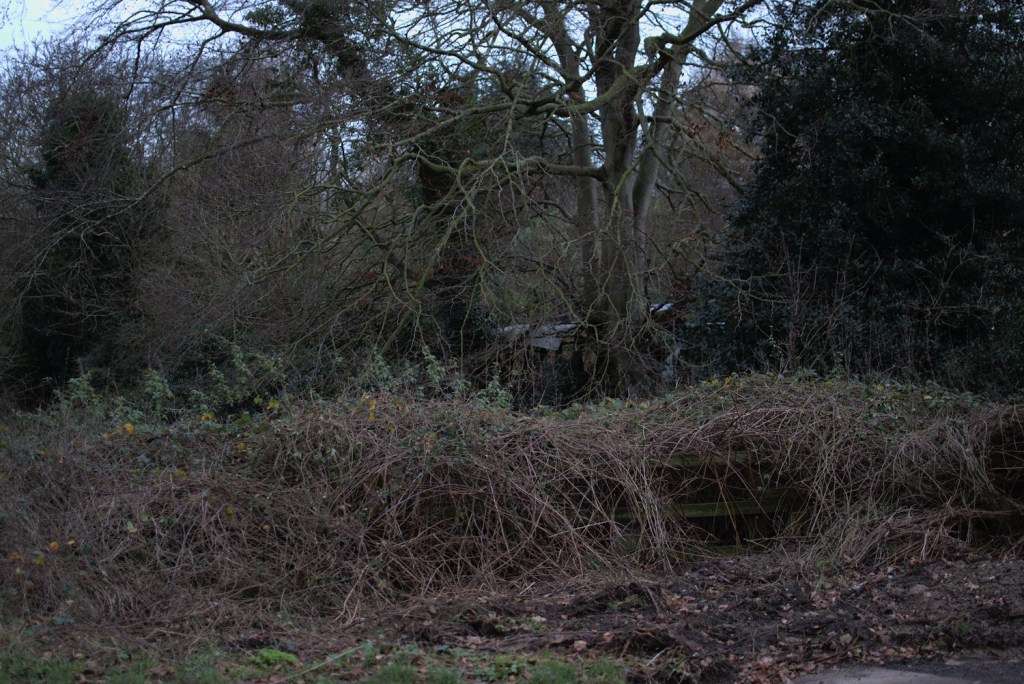
Between Mill Road and Chediston Street I am riding down a steep path towards a stream which feeds the Blyth. As it approaches a narrow bridge, ducking below the canopy, the path is built of railway sleepers topped with chicken wire. The woods to the west have been cleared to their far edge. Through the trees the land extends towards Linstead parish church, dedicated to St Margaret of Antioch, who died aged 15 in the last and most savage Roman persecution. Although her story is thought to be invented, she is said to have beaten a demon with a hammer and been savagely tortured following her refusal to marry a Roman Governor and renounce her faith. She was eaten by Satan and escaped by the power of her cross. St Margaret of Antioch was eventually decapitated. In the English church she is commemorated on 20th June. On my bike, too fast to be afraid, almost too dark to see the path now.

 Andy Small
Leave a comment