
St Lawrence, Ilketshall St Andrew.
There seemed like a tremendous storm gathering above the road to Bungay. I could not quite believe the scale of it. I slowed down and turned off the headlights. With my arms folded across the top of the steering wheel and my head turned up and pressed against the windscreen, a vast ocean of cloud swayed above. Textures like the traces of dough caught on a board after kneading. Lit from behind like the glow of a lamp seen from the street in a room with its curtains drawn. I thought there should be more noise, had I imagined rain on the windscreen or the roof? Just an occasional deep muffled booming.
St Lawrence church is on a hill rising to the East. I turned up this narrow road to pull over and watch the storm. I could make out the church and the trees and the low bank of the cemetery. There was no light to locate the house next to the churchyard gate. The storm had passed by the time I was home, but the church on Top Lane stayed with me. The cemetery crowning a low hill, its square flint tower with a star attached from last Christmas, and the windswept trees.
I swept past the church on a Spring evening. I was watching the North West horizon, following the setting Sun. The radio had promised a view of some planets. It was getting darker, and I couldn’t see them. The road turned and climbed towards Bungy swimming pool, and a corner of the sky that was still bright. I could see a row of tiny but intense spots of light that I thought at first were stars. These were planets, so minute and yet so ordered in their succession, pointing towards a Sun already below the horizon. On the same road before the millennium I saw a comet — brighter than I imagined, its tail pointing into the dark, star-filled sky over Spexhall.
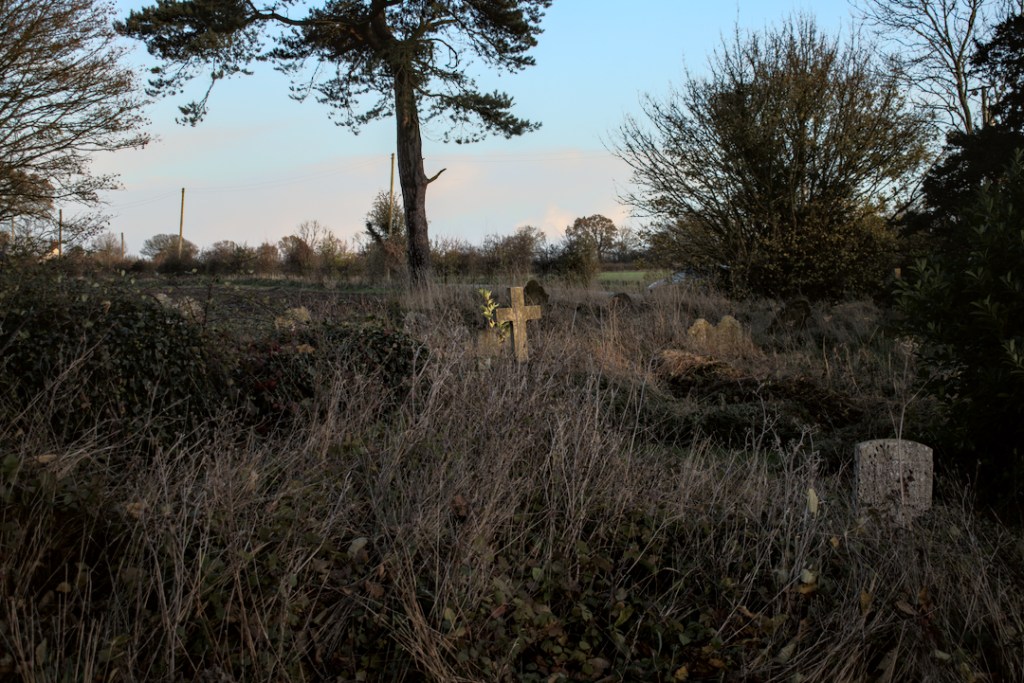
I went back to St Lawrence church on a bright winter afternoon. Some frost had melted, but not in the shadows. The path through the churchyard was patched with shallow puddles between rough white stones. The graves and the grass already darkening below a clear blue sky. Stems of wild grasses and patches of lichen, bright in the fading light. The sun is caught on the eastern end of the church, on the carved stonework, on the broken rendering, on exposed flints, and among the grass. On overgrown weeds and on a gravestone carved on the form of a cross.
 Andy Small
Leave a comment